
Data analytics vs. data science - what are the differences?
Data is the new gold, but only if you know how to mine it. But who is the right expert for this: a data analyst or a data scientist? The terms "data analyst" and "data scientist" are often used interchangeably, which often leads to confusion. Fortunately, we have experts from both fields at #temafida!
So that you know who and what is behind the terms in the future, we have written this article for you! We define the terms data science and data analytics, highlight the key differences and help you decide which expert from which discipline is the right one for your challenges.
Would you like to gain a foothold in one of these areas with your career? Then the training courses in our FIDAcademy could be just right for you!
Data analytics vs. data science
What is data analytics?
Data analytics focuses on examining data sets for patterns, correlations and causalities to gain insights into past and present trends. The main task of data analysts is to create data analyses and visualizations to support the company in making operational decisions.
A data analyst tries to answer questions such as"What happened?","Why did it happen?", or"What patterns are emerging?".

Typical tasks of a data analyst
A data analyst performs a variety of tasks in dealing with company data. The cornerstone isdata collection and cleansing, in which raw data from various sources is merged and prepared for further processing. Incorrect or incomplete data records are identified and corrected to ensure the quality of the analyses.
In the next step, the data analyst creates meaningful reports and interactive dashboards. These serve as a central source of information for decision-makers and provide a quick overview of the current business situation.
A particular focus is on the continuous analysis of key performance indicators (KPIs). The data analyst monitors important key figures such as sales development, customer satisfaction or process efficiency, identifies trends and deviations and thus provides valuable insights for strategic corporate management. This systematic data analysis makes a significant contribution to data-driven decision-making.
Tools of a data analyst
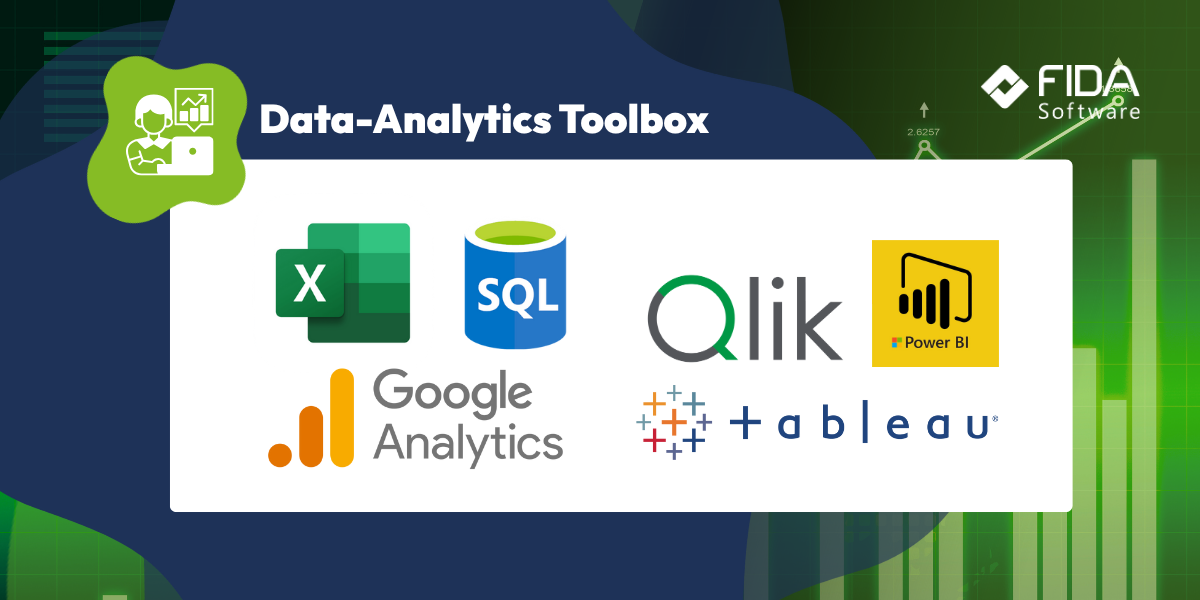
Data analysts work with a versatile tool set. SQL enables efficient database queries, while Excel remains indispensable for quick analyses. Google Analytics provides important insights into user behavior in the digital sector.
Tableau, Power BI and Qlik dominate the market for data visualization. These tools transform complex data sets into comprehensible, interactive dashboards and graphics for all stakeholder levels.
Data warehouses form the foundation of the data infrastructure. As central storage systems, they process large volumes of data from various sources and enable fast, company-wide analyses of historical data sets.
What is data science?
Data science is an interdisciplinary field that uses scientific methods, processes and algorithms to gain knowledge and make predictions from data sets using statistical analysis methods. To this end, the data scientist deals with the scientific principles of pattern recognition and classification of large amounts of data.
Data scientists answer questions such as"What is likely to happen next?" or"What can we do to achieve a certain result?".

Typical tasks of a data scientist
A data scientist takes on a variety of tasks, all of which are aimed at gaining knowledge from data and making it usable for practical applications. A central step is the development of hypotheses and the execution of experiments in order to test well-founded questions based on data. Statistical methods such as regression analyses or classification procedures can then be used to make predictions.
In addition, the aim of data science is to develop prediction models using machine learning algorithms in order to recognize complex patterns, make predictions or automate entire processes. A typical example is segmentation and classification, for example to identify different customer groups.
As data is rarely presented in a nice and handy format, processing large, unstructured amounts of data (big data) is also part of everyday life. This is precisely where the art of the profession lies: gaining useful insights from data chaos - the digital gold rush, so to speak, in which algorithms are used instead of shovels.
Tools of a data scientist
Data scientists work with sophisticated tools for complex data analysis and model development. Python has established itself as the leading programming language, supported by powerful libraries such as Pandas for data manipulation, NumPy for numerical calculations and Scikit-learn for machine learning. R remains an important alternative, especially in statistical analysis and research.
For deep learning and neural networks, data scientists rely on specialized machine learning frameworks. TensorFlow and PyTorch dominate this area and enable the development of complex AI models, from computer vision to natural language processing.
Big data technologies are used to process massive amounts of data. Apache Spark enables distributed data processing in real time, while Hadoop serves as a framework for storing and processing petabyte-sized data sets. These tools are indispensable when traditional database systems reach their limits.

A direct comparison of data analysts and data scientists
Data analytics and data science are two closely related disciplines that deal with the analysis and processing of data. While data analysts focus on analyzing past data to support operational business decisions, data scientists develop forecasts and approaches for future challenges:
Data analytics focuses on the statistical analysis of existing data sets in order to gain patterns and insights.
Data science uses statistical models, machine learning and deep learning to gain insights from large, often unstructured amounts of data.
Both professional groups are essential for data-driven strategies in companies. Data engineers play an important role in creating infrastructure and data pipelines for data analytics and data science. Both areas require expertise in data processing, analysis and interpretation.
Below you will find an overview of the differences between "Data Analyst vs Data Scientist":
A data analyst and a data scientist differ primarily in their focus, their time horizon and the methods used. While the data analyst is mainly concerned with understanding the past and the present, the data scientist focuses on predicting the future. The questions differ accordingly: The data analyst pursues the question "What happened and why?", whereas the data scientist deals with "What will happen and what should we do?".
This difference can also be seen in the time horizon: data analysts work retrospectively and in the present, while data scientists look ahead. Methodologically, the data analyst relies predominantly on descriptive statistics, data visualization and reporting. Data scientists, on the other hand, use more complex methods such as inductive statistics, machine learning, statistical modeling and algorithms.
The data sources used also vary. Data analysts work primarily with structured data such as numbers, names or dates. Data scientists also include unstructured data such as texts or images in their analyses. The results also differ accordingly: While data analysts deliver reports, dashboards and insights, data scientists develop predictive models, algorithms and prototypes.
Practical use cases: When do data engineers need to get to work?
Data analytics and data science can be used in almost every area of a company to make processes more efficient, reduce costs or make more informed decisions with the help of smart insights and forecasts.
We have compiled some practical examples for you:
For customers & product
Churn prediction (predicting customer churn): Customer behavior (e.g. decreasing usage frequency, fewer purchases, type of support requests) is analyzed to predict which of them have a high risk of not continuing to use the product. In this way, discounts, special services or new offers can be proactively presented to counteract this.
Sentiment analysis of customer feedback: Text mining can be used to analyze whether customers speak positively, neutrally or negatively about a brand. This quickly reveals whether a new campaign is being celebrated or viewed critically.
Personalized product recommendations (recommendation engines): Based on a customer's previous purchasing and surfing behavior, products or content that are most likely to interest them are automatically suggested to them. This increases sales per customer (cross-selling and up-selling).
Analysis of product usage (feature adoption): With software or apps in particular, it is crucial to know which functions users use most frequently (or not at all). By analyzing usage data, it is possible to identify where the strengths and weaknesses of the product lie and where further development is worthwhile.
Customer Lifetime Value (CLV): Based on previous purchasing behavior, an estimate is made of the total revenue a customer is likely to bring in during their "life cycle". This helps with the targeted use of marketing budgets.
For operations & processes
Forecasting demand and sales: Data scientists model the likely demand for certain products depending on the season, weather, trends or even sporting events. Perfect for managing stock levels or personnel planning.
Predictive maintenance: In industry, sensor data from machines (e.g. temperature, vibration) is analyzed to predict when a component is likely to fail. Instead of waiting for an expensive breakdown, maintenance can be carried out exactly when it is needed. This saves costs and prevents production downtime.
Optimization of warehousing and supply chain: Demand for certain products in different regions can be predicted using data analysis and data science (demand forecasting). In this way, stock levels can be optimized to avoid supply bottlenecks and at the same time reduce the cost of surplus goods.
Quality assurance in production: Defects in components can be detected automatically using image recognition via computer vision, thus avoiding expensive errors.
For pricing & finance
Dynamic pricing: Airlines, hotels or ride-sharing services dynamically adjust their prices to current demand, competitor prices, time of day and other factors. The aim is to maximize revenue through flexible pricing.
Credit risk assessment (credit scoring): Based on hundreds of data points of an applicant (income, previous credit history, place of residence, etc.), the probability of a credit default can be calculated. This helps banks to make informed decisions about granting loans.
Fraud detection: Banks, insurance companies and e-commerce companies analyze transaction data in real time. Algorithms recognize patterns that indicate fraud (e.g. unusual place of purchase, atypical purchase amount) and can automatically block suspicious transactions.
Do professions in data analytics and data science have a future?
The importance of data analysts and data scientists will continue to grow as companies increasingly rely on data-driven decisions. The demands on data experts will continue to rise as companies rely more and more on complex data analyses.
However, in light of current technological developments, data analysts and data scientists are facing a turning point. Generative AI is democratizing access to data analysis and making complex evaluations accessible to more people. At the same time, the boundaries between the two disciplines are increasingly blurring.
The automation of standard analyses and model development is drastically accelerating work processes. This allows specialists to concentrate on higher-value tasks: understanding complex interrelationships, developing solutions and translating technical findings into business value.
New challenges arise from the growing volume and complexity of data. Real-time analytics, edge computing and the integration of unstructured data are becoming the standard. At the same time, topics such as data protection, algorithmic fairness and comprehensible AI decisions are coming into focus.
The future belongs to data experts who combine technical expertise with business understanding and ethical awareness. They will become indispensable navigators in an increasingly data-driven world.
Conclusion: data engineers are not competitors
Data analytics explains what was, while data science predicts what could be. Both disciplines are crucial for a future-oriented, data-driven company. Data analytics often identifies the problems for which data science then develops predictive solutions. Choosing one of the two disciplines does not depend on which is "better", but on what questions you currently need to answer for your company.
FAQ - What is the difference between data science and data analytics?
Data analytics focuses on analyzing historical and current data in order to identify patterns, trends and causes and support operational decisions.
Data science involves not only data analysis, but also the development of models and algorithms (e.g. machine learning) with the aim of making predictions or establishing automated processes.
Data analytics uses tools such as SQL, Excel, BI tools, dashboards and data warehouses. Data science also relies on programming languages (e.g. Python, R), machine learning libraries and big data technologies.
A data analyst prepares and visualizes data and provides insights for operational decisions. A data scientist formulates hypotheses, develops models, works with complex data sets and uses advanced methods.


